
'/%3E%3C/svg%3E)





Artificial intelligence is rapidly transforming how organisations capture information, create documentation, automate processes and deliver services.
Across healthcare, legal services, emergency services and the wider public sector, AI technologies are being integrated into daily workflows to improve efficiency, reduce administrative burden and support better outcomes.
As organisations embrace these technologies, a new question is emerging:
Who controls the information, systems and AI services that organisations increasingly depend on?
For many years, conversations around data protection focused primarily on security and compliance. Today, organisations must think more broadly. They must consider data sovereignty.
While often confused with data residency, data sovereignty extends far beyond where information is physically stored. It encompasses ownership, control, governance, legal jurisdiction and operational independence.
As AI becomes embedded into critical business processes, understanding data sovereignty has never been more important.
Understanding Data Sovereignty
Data residency refers to the physical location where data is stored.
For example, an organisation may choose to host its information within the United Kingdom, Germany or another specific country to meet regulatory requirements.
Data sovereignty goes further.
It considers:
- Who owns the data
- Who can access the data
- Which legal jurisdiction applies
- How information is processed
- Which technologies are used
- Whether organisations can retain control over their information and workflows
In simple terms, data residency focuses on location. Data sovereignty focuses on control.
An organisation may have data stored within its own country but still rely heavily on technology providers, infrastructure providers or AI providers that operate under different jurisdictions and controls.
This distinction is becoming increasingly important as AI services become part of everyday operations.
The Growing Dependence on AI
Many organisations now rely on AI to assist with:
- Speech recognition
- Ambient documentation
- Clinical documentation
- Legal drafting
- Case summaries
- Workflow automation
- Information extraction
- Decision support
These technologies can deliver significant productivity gains and improve service delivery.
However, they also introduce new dependencies.
Every AI service relies on underlying infrastructure, providers, models and policies that organisations often have little visibility into.
This raises important questions:
- What happens if an AI provider changes its terms?
- What happens if access to a model becomes restricted?
- What happens if regulations change?
- What happens if a provider discontinues a service?
- What happens if organisations need to move to another platform?
The more critical AI becomes to daily operations, the more important these questions become.
Data Sovereignty Is No Longer Just a Compliance Issue
Historically, discussions around sovereignty were often driven by compliance teams.
Today, they are increasingly being driven by operational leaders, technology leaders and executive teams.
Why?
Because sovereignty is now closely linked to resilience.
Organisations need confidence that critical services can continue operating regardless of market changes, regulatory developments or supplier decisions.
This is particularly important within sectors that manage sensitive information and essential services.
Healthcare organisations manage patient records and clinical information.
Legal organisations manage confidential client information.
Emergency services manage operationally sensitive incident data.
Public sector organisations manage information that directly impacts citizens and communities.
For these organisations, maintaining control is not simply desirable. It is essential.
The Risks of Vendor Dependence
Many modern technology platforms are built around a single provider ecosystem.
While this can simplify implementation, it can also create long-term dependency.
Vendor lock-in occurs when organisations become so reliant on a particular technology, service or provider that changing becomes difficult, expensive or disruptive.
This can limit flexibility and increase risk.
Organisations should carefully consider:
- How easily can systems be migrated?
- Are alternative providers available?
- Can workflows continue if a service changes?
- Is data portable?
- Are integrations open and accessible?
These questions become increasingly important as AI capabilities continue to evolve.
Technology strategies that appear suitable today may need to adapt significantly over the next five years.
Data Sovereignty and AI Governance
Effective AI governance should include data sovereignty considerations from the outset.
Organisations should understand:
- Where information is processed
- Which models are being used
- How data is protected
- How outputs are generated
- What oversight exists
- How decisions can be audited
Human oversight remains a critical component of responsible AI adoption.
Particularly in healthcare, legal and public sector environments, AI-generated outputs should support professionals rather than replace professional judgement.
Maintaining governance and accountability helps organisations balance innovation with control.
Building a Sovereignty-First Strategy
There is no single approach that suits every organisation.
However, there are several principles that can help strengthen sovereignty.
Flexible Deployment Models
Different organisations have different requirements.
Some may prefer cloud deployments.
Others may require private cloud, hybrid or on-premise environments.
The ability to choose the deployment model that aligns with operational and regulatory requirements is an important part of maintaining control.
Data Ownership and Transparency
Organisations should retain clear ownership of their information and understand exactly how it is being used.
Technology providers should be transparent about data handling, storage and processing practices.
Choice of Technology
Organisations should avoid unnecessary dependence on a single technology provider where practical.
The ability to adopt different AI engines, speech technologies and supporting services provides greater flexibility for the future.
Open Integration
Systems should integrate easily with existing technologies and workflows.
Open integration capabilities help organisations adapt as requirements evolve.
Human Oversight
AI should enhance professional expertise, not remove it.
Human review and validation remain essential, particularly where sensitive information or important decisions are involved.
The Future of Sovereignty
The conversation around data sovereignty will continue to evolve as AI capabilities expand.
Future discussions are likely to focus not only on where data is stored, but also on:
- Model sovereignty
- Infrastructure sovereignty
- AI governance
- Supply chain resilience
- Digital independence
Organisations that address these considerations early will be better positioned to adapt to changing technologies and regulatory environments.
The Diktamen Approach
At Diktamen, we believe organisations should remain in control of their information, workflows and technology choices.
Our platform is designed to support a range of deployment models, including cloud, private cloud, hybrid and on-premise environments.
We recognise that different organisations face different operational, regulatory and security requirements.
As AI technologies continue to evolve, flexibility, transparency and control will remain fundamental principles.
Innovation is important.
But innovation should never come at the expense of organisational control.
Conclusion
AI is creating new opportunities for organisations to improve productivity, automate processes and deliver better services.
At the same time, it is introducing new questions around control, governance and resilience.
Data sovereignty is no longer simply about where information is stored.
It is about ensuring organisations retain control over their data, their workflows and the technologies that support them.
As AI becomes increasingly embedded into critical operations, sovereignty will become a defining factor in how organisations evaluate and adopt technology.
The organisations that prioritise sovereignty today will be better prepared for the challenges and opportunities of tomorrow.
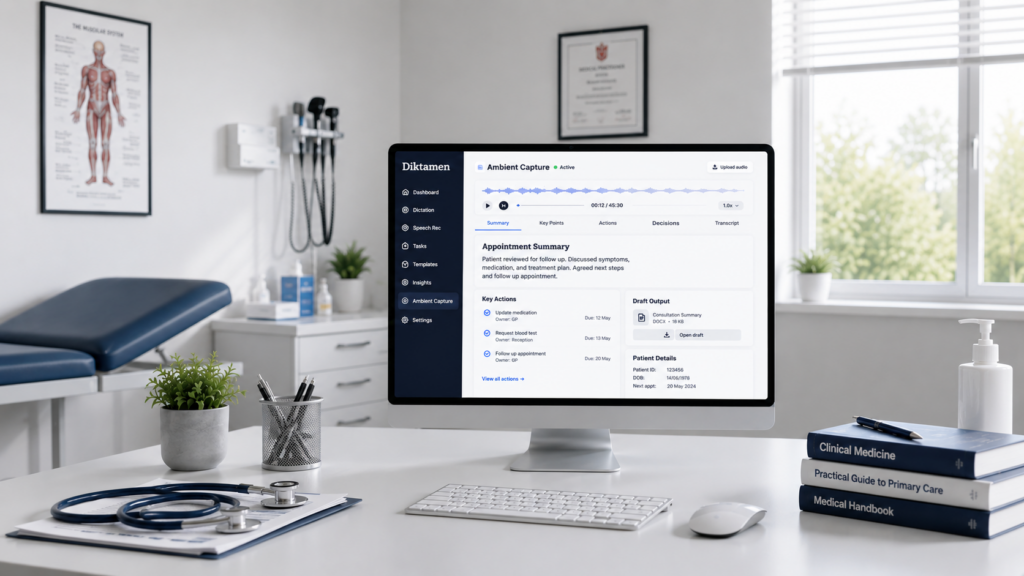
Considering Ambient Capture?
Diktamen supports this combined approach by bringing together AI-generated outputs, clinician-led dictation, and human transcription within a single workflow.
If you would like to explore how this works in practice, get in touch to arrange a demonstration.